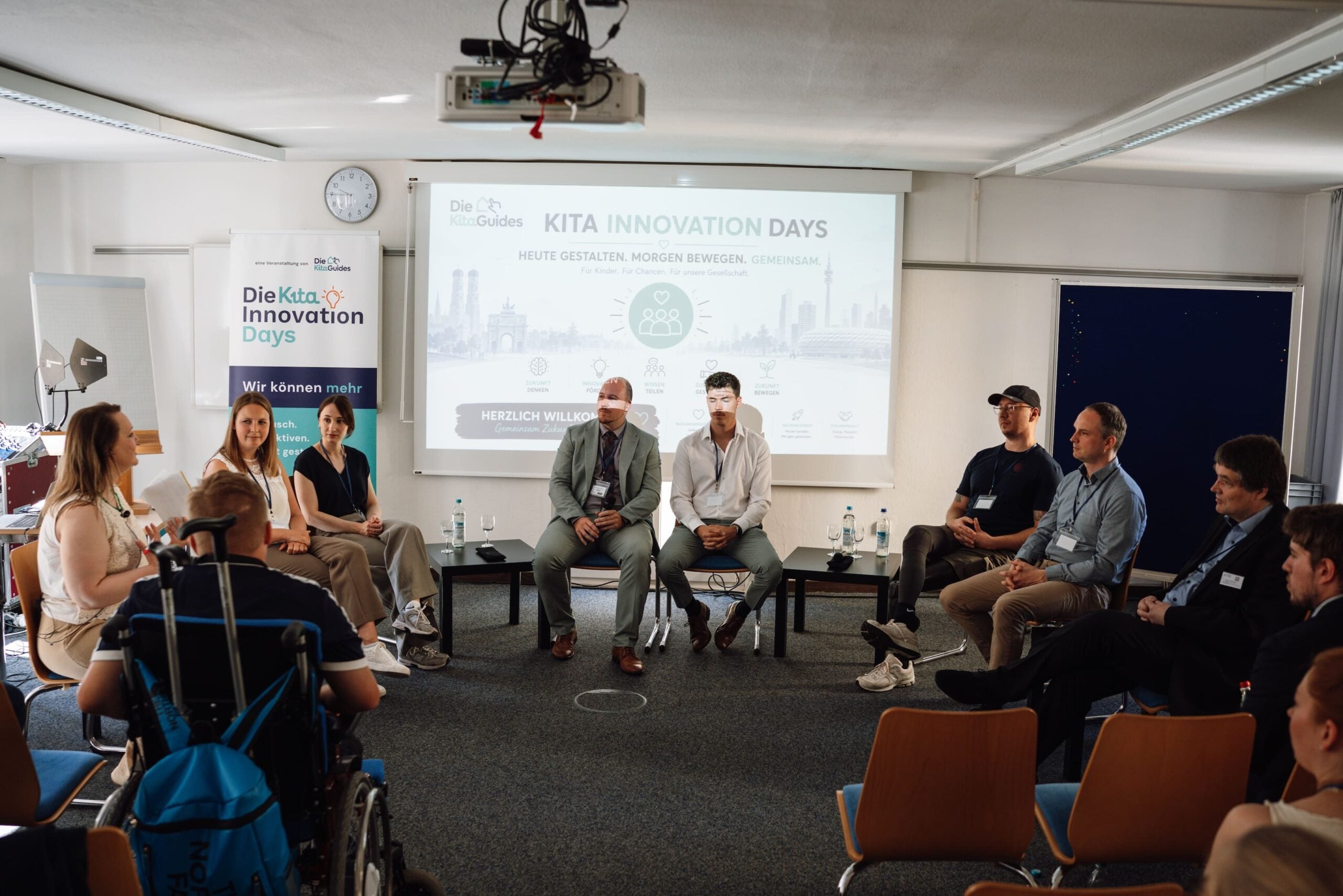
Schifferstadt / Munich, July 7, 2026. At this year’s Kita Innovation Days in Munich, industry experts engaged in intense discussions about the future of early childhood education. Right in the middle of it: Sebastian Götz, founder of Kita Digital, who made a clear plea on the panel against global cloud services and digital documentation bureaucracy, demanding noticeable relief for early childhood educators during the panel discussion on “Human and AI: Opportunities and Challenges for Education and Society.”
“Digitalization projects in childcare centers usually fail when technology is conceived purely top-down by the administration rather than from the grassroots level,” Götz emphasized to the highly attended professional audience. If new software for educators in an already stressful daily routine merely means managing additional passwords, software updates, and Excel spreadsheets, it creates administrative bloat rather than relief. Understandably, team motivation drops to zero as a result.
The Solution: An Invisible Assistant Based on an Anti-Bias Approach Technology must instead feel like an invisible assistant that gives back valuable time for pedagogical work with the child. As a concrete solution, the Schifferstadt-based entrepreneur presented his internally developed early childhood educational model, “EleMo,” to the professional audience. The specialized AI was specifically fine-tuned to the criteria of a prejudice-conscious education: The model is optimized to operate according to anti-bias principles and to pay sensitive attention to diversity.
EleMo supports educational professionals in creating professionally sound educational documentation or developmental reports from short, unstructured pedagogical observations in a matter of seconds. On average, professionals today spend 30 to 50 minutes per child writing such reports, mostly because they are staring at the proverbial “blank page.”
The Privacy-Friendly Moat: 100% Local and Offline A particularly important point for Götz is the shift away from global cloud services toward digital sovereignty: The AI system runs decentrally and completely offline on local hardware directly within the institutions to consistently meet the strict data protection requirements of the GDPR. Through the enormous time savings in reporting, the looming threat of deskilling (the loss of one’s own pedagogical judgment to algorithms) in practice is meant to be transformed into qualitative upskilling through targeted, assisted reflection.
The huge interest from the professional audience and from childcare providers immediately following the event clearly demonstrated how pressing the topics of data security and noticeable relief are in today’s childcare landscape. Götz successfully used the platform in Munich for intensive expert discussions, informing providers about the decentralized infrastructure and acquiring important new clients right in this phase.
Strong Media Presence, Professional Textbook, and Regional Roots How the balancing act between technological innovation and uncompromising data protection succeeds in everyday early childhood education is something Götz is also exploring in depth in his next major project: The publication of his practical textbook on the use of AI in childcare centers, published by the renowned Kohlhammer Verlag, is planned for the coming year.
That pioneering technological innovation and deep local roots can form a powerful symbiosis is also proven by an upcoming regional highlight, which underscores the broad media attention for the founder: Sebastian Götz has been officially appointed as the 2026 Wine Patron (Weinpate) for the Rhein-Pfalz-Kreis. The festive ceremony will take place on August 14, 2026, in the historic ambiance of the Schlossgarten Fußgönheim and will serve as an excellent multiplier for the startup to bring together decision-makers from politics, associations, and municipal providers.